
Anthropic Launches Claude Design for Non-Designers
Anthropic introduces Claude Design, a tool for non-designers to create visuals easily. The product targets founders and product managers looking to share ideas quickly.
All 3,468 AI stories, newest first · page 132 of 145
Anthropic introduces Claude Design, a tool for non-designers to create visuals easily. The product targets founders and product managers looking to share ideas quickly.

Operating 14 AI agents for half a year revealed critical insights on scalability, cost, and reliability. The experience highlights the need for robust infrastructure and continuous monitoring.

Researchers demonstrate that complex routing mechanisms in sparse Mixture-of-Experts (MoE) models don't significantly affect language modeling performance. A simple geometric routing approach with 80% fewer parameters performed comparably to standard methods.

Runway's CEO suggests AI tools could revolutionize Hollywood by allowing studios to produce 50 films for the cost of a single $100 million blockbuster. This shift could dramatically increase the odds of creating hit movies.

A new paper on arXiv proposes a formalization of Kantian ethics to address limitations in current AI moral frameworks. The approach aims to incorporate an agent's purposes and avoid the assumption that humans can fully enumerate their moral intuitions.
Pneuma-Seeker is a new AI system designed to help data analysts refine their questions and explore relational data iteratively. It uses LLMs to create transparent, interactive analytical processes for real-world applications like procurement.

Physical Intelligence's new π0.7 model can perform tasks it wasn't explicitly trained for, marking progress toward general-purpose robotics. This breakthrough could revolutionize automation and robotics applications.

OpenAI has significantly enhanced its Codex system with new features like computer interaction, image generation, and contextual memory. This move is seen as a direct response to Anthropic's Claude Code, intensifying the competition in AI-driven development tools.

OpenAI has expanded Codex's capabilities beyond coding to include general computer use, in-app browsing, and image generation. This update aims to accelerate developer workflows with new memory and plugin features.

OpenAI has introduced GPT-5.4-Cyber, a specialized model for cybersecurity, along with $10M in API grants to bolster global cyber defense. Leading security firms and enterprises are joining OpenAI’s Trusted Access for Cyber initiative.

NVIDIA has released Isaac GR00T N1.7, an open-source reasoning model designed for humanoid robots. This model enables advanced decision-making and interaction capabilities for robotic systems.

Researchers propose NuHF Claw, a risk-constrained AI agent framework designed to support human operators in digital nuclear control rooms. The system aims to mitigate cognitive risks while maintaining human authority in safety-critical environments.
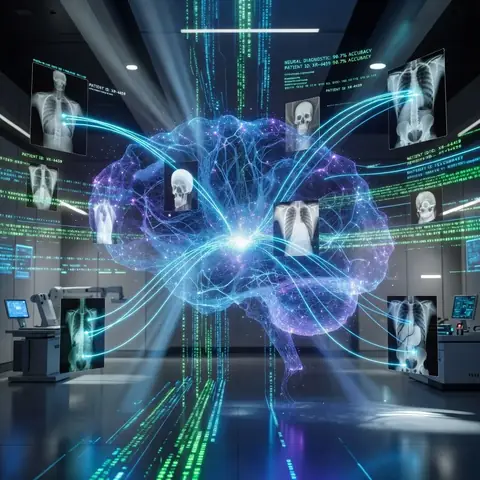
Researchers developed a model that learns from radiologists' gaze patterns and diagnostic workflows. This approach improves X-ray interpretation by aligning with expert reasoning processes.

A comprehensive survey reviews the use of Explainable AI (XAI) to make surrogate models more interpretable. The study highlights the need for transparency in complex simulations across scientific and engineering fields. This work offers a roadmap for integrating XAI into decision-making processes.

Researchers propose a novel approach merging model pruning and prompt compression to reduce LLM size and latency. The method adapts to different prompts and decoding steps for dynamic efficiency.
Researchers propose a new learning rule where AI models only update when they make mistakes, reducing energy and memory usage. This approach mimics the human brain's negativity bias and could revolutionize continual learning in artificial neural networks.
Researchers have used AI to generate and verify formal proofs for a compiler, marking a milestone in AI-assisted formal verification. This could revolutionize software reliability by automating complex proof tasks.

As AI-generated code becomes more prevalent, formal verification is crucial to ensure reliability and security. This shift requires new tools and methodologies to validate machine-written software.

Researchers propose a heartbeat-driven scheduling system for LLM-based AI agents, enabling proactive self-regulation. This approach mimics human cognition to improve adaptability and efficiency. The study highlights the limitations of current rigid control flows in AI systems.
Google has launched Stitch, an AI tool designed to streamline the creative process for designers. It offers advanced features to enhance productivity and innovation in design workflows.

Researchers propose Group Fine-Tuning (GFT), a method that combines imitation and reward learning to improve LLM training. GFT addresses key challenges like single-path dependency and gradient instability.

Researchers demonstrate that individual experts in sparse Mixture-of-Experts (MoE) models have causally meaningful identities. This discovery enables more precise control over model behavior through geometric routing techniques.

Google's Gemini AI can now pull from Google Photos to create personalized images. This feature leverages the Nano Banana 2 model for tailored visual content based on user data.

Researchers introduce Fun-TSG, a function-driven tool for generating multivariate time series with detailed anomaly labels. This addresses key limitations in current benchmark datasets for anomaly detection.