
OpenAI Reveals Stance on AI Policy and Political Advocacy
OpenAI has outlined its approach to AI policy, emphasizing transparency and support for thoughtful regulation. The company clarifies that no external groups speak on its behalf.
All 3,125 AI stories, newest first · page 70 of 131
OpenAI has outlined its approach to AI policy, emphasizing transparency and support for thoughtful regulation. The company clarifies that no external groups speak on its behalf.

OpenAI is reportedly developing a 'super app' that could replace multiple specialized apps. This could change how we use AI in our daily lives, making it more integrated and seamless.

New York lawmakers have passed a one-year moratorium on new large data centers. This pause aims to assess the environmental and economic impact of these facilities on the state.

Meta has introduced a 'For You' feed in its standalone AI app that is entirely filled with AI-generated clickbait articles. The topics, images, and text are all created by AI, raising questions about misinformation and the blurring line between real and fake news.

AI agents are becoming more powerful, but their terminology can be confusing. Understanding key terms like 'harness' and 'scaffold' helps clarify how these tools work and what they can do. These concepts are crucial for both developers and users to grasp as AI agents evolve.

Hugging Face has released a new command-line interface (CLI) designed to streamline interactions with their AI model Hub. This tool makes it easier for developers and AI enthusiasts to manage models and datasets directly from their terminal.

PyTorch's torch.profiler helps you find performance bottlenecks in your AI code. It's a powerful tool for developers, even if you're new to optimization.

Google published exploit code for a vulnerability in Chromium that was reported over three years ago. The bug has now been fixed, but the exploit code was released before the patch was available, putting millions of users at risk. The company claims it's a rare exception to policy.

Red Hat has confirmed that multiple packages in its official NPM channel were backdoored, and anyone who has downloaded the affected packages should investigate immediately. The attack is a supply chain compromise through the company's own official npm channel.

Dashlane has explained how attackers managed to download encrypted password vaults by targeting many users at once, increasing their odds of success. The company says no master passwords were compromised, but the incident underscores the importance of strong security practices.

A newly discovered zero-day exploit completely defeats Windows 11's default BitLocker encryption. Microsoft says it's investigating but has not yet provided a fix. The exact mechanism is unclear, but the flaw could leave millions of users vulnerable to data theft.

Apple’s WWDC 2026 will showcase a revamped Siri and new Apple Intelligence features. Expect smarter, faster AI tools integrated into everyday apps, including the long-awaited 'LLM Siri' that can handle complex on-screen tasks.

Airbnb is launching an AI lab to develop its own AI tools. This could change how we book and experience travel. The lab will focus on creating AI solutions tailored for the travel industry.

Quilty, an AI startup, says its tool can predict a film's success by analyzing the script. Early users, however, remain skeptical about its accuracy after testing the product.

AI-generated content creators are improving so quickly that even experts struggle to tell them apart from humans. This blurs the line between real and artificial influencers, raising ethical and trust concerns.

Major AI companies are planning to go public, which could lead to higher prices for their services. This is part of a broader trend where companies adjust their pricing strategies as they prepare for public markets, potentially marking the start of a 'Tokenpocalypse' for users.

Researchers introduced TimeClaw, an agentic framework that improves time series analysis by integrating rich contextual information and supporting end-to-end workflows. This could make tools for forecasting and pattern analysis more accurate and practical for real-world applications.

Researchers built a multi-agent economy simulation using a small AI model with just 3 billion parameters. This shows how powerful even modest-sized models can be for complex tasks.

OpenAI has released a comprehensive plan to use AI for biological threat detection and response. This initiative aims to make biodefense more proactive and efficient for everyone.

OpenAI has launched Lockdown Mode to prevent sensitive data leaks from AI models. While not foolproof, it significantly reduces the risk of prompt injection attacks.

At its developer conference, Nvidia's Jensen Huang described a completely new way of using laptops, powered by AI that anticipates your needs and adapts to your workflow. This could make computers feel more like intuitive personal assistants than traditional tools.

Researchers have proposed a new motivational architecture for AI that focuses on conversational agents. The architecture reinterprets the OpenPsi motivational lineage for linguistic interactions, aiming to make future AI assistants more engaging and responsive to human mental states.
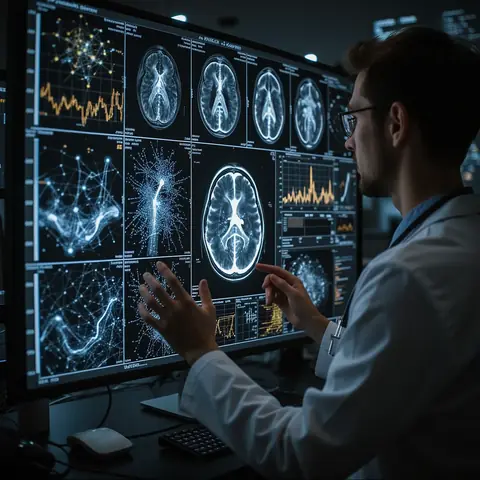
Researchers developed an AI system that predicts knee pain from MRI scans with high accuracy. The framework combines deep learning and statistical modeling to make the results interpretable and trustworthy.

Google is paying SpaceX a staggering $920 million per month for computing power to support its AI products. This deal highlights the massive demand for advanced AI infrastructure.