Mirror AI: Self-Improving Video-to-Action Models
Summarized by AI from reporting by ArXiv cs.AI, published under our editorial policy.
Researchers introduced Mirror, a self-supervised AI system that learns to translate videos into actions through environment interactions, eliminating the need for large human-collected datasets and making robots more adaptable.
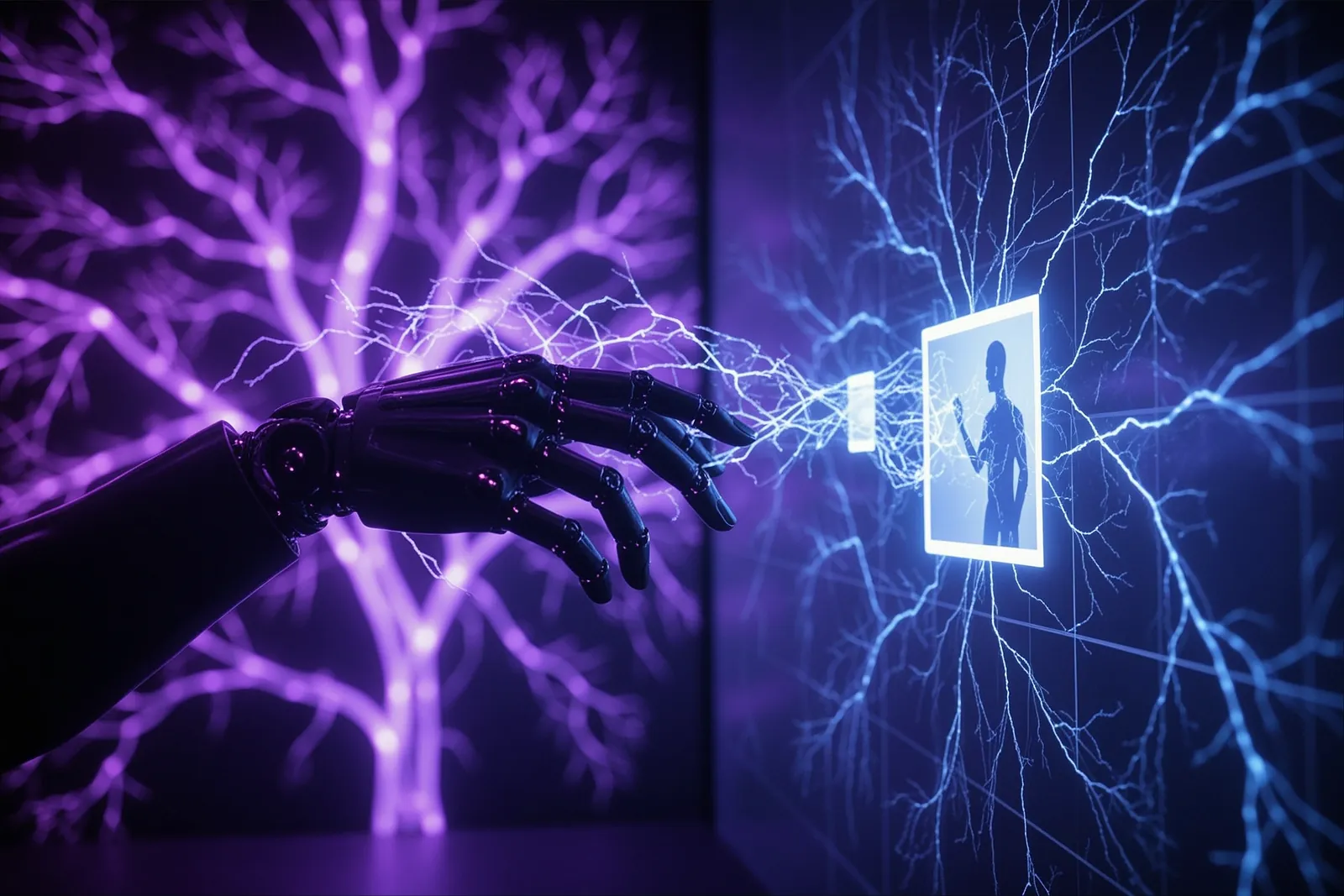
Key takeaways
- Mirror is a self-supervised AI system that learns video-to-action mappings without human-collected data.
- Traditional video-to-action models rely on large, human-collected datasets, limiting their scalability.
- Mirror's ability to learn from environment interactions makes it more adaptable to new tasks.
- This technology could revolutionize fields like home automation, healthcare, and manufacturing.
Researchers introduced Mirror, a new self-supervised AI system that learns to translate videos into actions without relying on human-collected datasets. This breakthrough could make robots and AI agents more adaptable to new tasks by learning from their own experiences.
How Mirror Learns Without Human Data
Mirror is a self-supervised approach that learns video-to-action mappings through environment interactions. Unlike traditional models that require large, human-collected video-action datasets, Mirror learns by interacting with its environment and improving its own performance over time. This means it can adapt to new tasks without needing extensive pre-existing data.
The Scalability Advantage of Self-Supervision
The key innovation of Mirror is its ability to learn without prior action data or hand-crafted rewards. Traditional video-to-action models, often referred to as "inverse dynamics" models, rely heavily on large datasets of human actions. These datasets are time-consuming and expensive to collect. Mirror, on the other hand, learns from its own interactions, making it more scalable and adaptable.
Why It Matters for Everyday People
This technology has significant implications for the future of robotics and AI agents. Imagine a robot that can learn to perform new tasks by watching a video and then practicing on its own. This could revolutionize fields like home automation, healthcare, and manufacturing, where adaptability is crucial. For example, a household robot could learn to perform new chores by watching a quick tutorial video, making it more useful and versatile.
Current Status and Next Steps
Mirror is still in the research phase. The paper is available on arXiv, where cutting-edge AI research is often first published. Existing AI-powered tools that use video-to-action models, such as robotic assistants and smart home devices, show how this technology is already being applied in real-world scenarios.
Frequently asked
- Is Mirror available for public use?
- No, Mirror is still in the research phase and not yet available for public use.
- How does Mirror differ from traditional video-to-action models?
- Mirror learns from its own interactions with the environment, while traditional models rely on large, human-collected datasets.
- What are the potential applications of Mirror?
- Mirror could be used in fields like home automation, healthcare, and manufacturing to create more adaptable robots and AI agents.