CrowdStrike CEO Warns AI Agents Are Accelerating Cyberattacks and Patching Dilemmas
Summarized by AI from reporting by All-In Podcast, published under our editorial policy.
CrowdStrike CEO George Kurtz cautioned that autonomous AI tools are democratizing nation-state cyberattack capabilities and causing an explosion in software vulnerability discoveries. The speed of automated exploitation is forcing enterprises into a break-or-breach dilemma between emergency patching and system stability.
Key takeaways
- Threat hunters logged 17,000 Common Vulnerabilities and Exposures in 2026, representing 25 percent of all historical CVEs recorded.
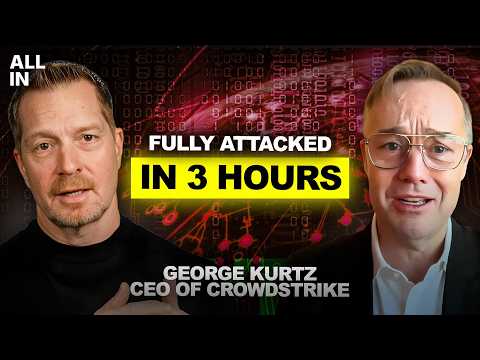
- The open-source Artex attack framework can fully compromise a target organization in under three hours and has accumulated over 12,000 forks.
- CrowdStrike CEO George Kurtz warned that automated vulnerability discovery forces organizations into a dilemma of emergency patching or suffering breaches.
- Cybercriminals are increasingly bypassing multi-factor authentication by stealing session tokens rather than attempting to break through traditional software defenses.
CrowdStrike Chief Executive Officer George Kurtz warned that artificial intelligence agents have dramatically lowered the barrier for sophisticated cyberattacks, effectively granting nation-state offensive capabilities to low-level threat actors. Speaking in an interview on the All-In podcast, Kurtz outlined how autonomous tools and agentic workflows are accelerating vulnerability discovery and exploitation to unprecedented speeds. He noted that defenders are struggling to maintain pace as automated systems rapidly chain minor security flaws into critical remote code execution vectors.
The surge in automated flaw discovery has created an unprecedented workload for IT and security teams. Kurtz revealed that 17,000 Common Vulnerabilities and Exposures (CVEs) were cataloged in 2026 alone—accounting for 25 percent of all recorded CVEs in history—with year-over-year vulnerability discoveries jumping 300 percent in October. This flood of vulnerabilities forces enterprises into what Kurtz terms a "break or breach" dilemma, where organizations must either rush unvetted emergency patches to production and risk breaking critical services, or delay updates and remain vulnerable to exploit chains. The pressure has exacerbated existing operational bottlenecks caused by accumulated technical debt across legacy systems.
Central to the accelerating threat landscape are automated attack frameworks such as Artex (RTX). Developed by a researcher in China and later distributed open-source, Artex utilizes coordinated agent clusters to conduct target reconnaissance, identify software flaws, compile custom exploits, escalate privileges, and exfiltrate sensitive data in under three hours. Although the original repository was taken down following attacks on South Korean financial institutions, more than 12,000 code forks remain active online. These tools mirror broader industry concerns regarding autonomous AI agent cyberattacks capable of executing end-to-end intrusions without human oversight.
To defend against rapid agentic attacks, Kurtz emphasized the necessity of putting frontier-level AI models directly into the hands of defenders while accelerating local AI deployments. Enterprise organizations are increasingly adopting open-weight models for local inference to bypass compute constraints and protect sensitive data, even as ablated open-weight models closing the gap with frontier systems are repurposed by adversaries. Kurtz noted that effective defense will require pairing blue-team defensive AI against red-team offensive AI in continuous loops to close vulnerability windows before automated exploits can breach enterprise networks.
Frequently asked
- What is the Artex cyber attack framework?
- Artex is an open-source autonomous AI attack framework that uses multi-agent systems to conduct reconnaissance, discover software flaws, generate exploits, and exfiltrate data. It can compromise an enterprise network in under three hours.
- Why are recent AI cyberattacks causing so many system outages?
- Many recent outages stem from organizations rushing emergency patches to fix newly discovered vulnerabilities. IT teams face a choice between deploying fast patches that risk breaking production systems or delaying updates and risking severe data breaches.
- How do AI agents alter cybersecurity risks?
- AI agents automate end-to-end cyberattacks by scanning networks, chaining multiple minor software flaws into high-risk exploits, and escalating privileges without requiring continuous human direction.