Web Agent Bridge: Open-Source OS for AI Agents Launched
Web Agent Bridge introduces an open-source operating system for AI agents, combining MIT and Open Core licensing. It aims to standardize AI agent development and deployment.
250 stories tagged AI Agents · page 10 of 11
Web Agent Bridge introduces an open-source operating system for AI agents, combining MIT and Open Core licensing. It aims to standardize AI agent development and deployment.

A new open-source project called Rigor aims to prevent AI services from degrading over time. It acts as a proxy for OpenCode and Claude Code, grounding projects in an epistemic graph with LLM-based evaluation.

Startups are grappling with how to safely provide AI/ML teams with production database access. The challenge differs from traditional BI tools in ways that aren't yet fully understood. The question of where agents should connect—primary, read replica, or warehouse—remains unresolved.

Operating 14 AI agents for half a year revealed critical insights on scalability, cost, and reliability. The experience highlights the need for robust infrastructure and continuous monitoring.

Researchers propose NuHF Claw, a risk-constrained AI agent framework designed to support human operators in digital nuclear control rooms. The system aims to mitigate cognitive risks while maintaining human authority in safety-critical environments.

Researchers introduce Credo, a framework for declarative control of LLM pipelines using beliefs and policies. It aims to make agent behavior more transparent and adaptable than current imperative approaches.

Fleeks is a new infrastructure platform designed to remove bottlenecks for AI agents, enabling them to execute, verify, and integrate code seamlessly. The platform aims to bridge the gap between code generation and real-world application.

Researchers introduce a lightweight parallel monitoring system to detect and recover from reasoning degradation in LLM agents. The Cognitive Companion reduces overhead compared to existing solutions. The study shows promise in mitigating issues like looping and drift in multi-step tasks.

OpenAI has updated its Agents SDK with native sandbox execution and a model-native harness, enabling developers to build secure, long-running agents. This advancement simplifies the integration of AI agents across various files and tools.

Researchers introduce HORIZON, a diagnostic benchmark to analyze failures in LLM-based agents on long-horizon tasks. The study highlights the need for better characterization of these failures to improve agentic systems.
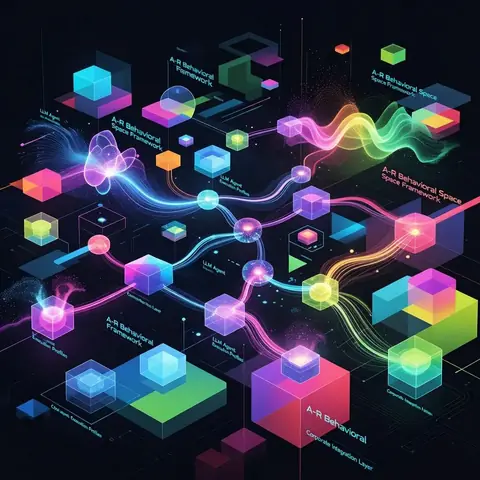
Researchers introduce a novel framework to profile tool-using LLM agents in organizational settings. The A-R space measures action rates and refusal signals, offering insights into agent behavior under different autonomy levels.

IBM Research has introduced VAKRA, a new benchmark for assessing agents' reasoning, tool use, and failure modes. The benchmark aims to provide a standardized way to evaluate agent capabilities across various tasks.

Researchers introduce AlphaEval, a methodology to assess AI agents in real-world scenarios. It addresses gaps in current benchmarks that fail to capture production complexities.

Researchers introduce a new benchmark for evaluating the humanization of mobile GUI agents, framing the challenge as an optimization problem. This work highlights the need for agents to evade detection in human-centric digital ecosystems.
Soul.md is a new open format designed to give AI agents persistent identities. It aims to standardize how AI agents are identified and remembered across different platforms.
Researchers developed proactive AI agents that assist human support teams by learning from unresolved issues and improving continuously. This approach could significantly reduce the workload on human analysts in large-scale cloud service platforms.
Researchers propose a multi-anchor architecture to prevent AI agents from losing their 'self' due to memory overflow. This approach draws inspiration from human memory systems to ensure continuity and resilience.

Researchers introduce SEA-Eval, a benchmark to evaluate self-evolving agents that can learn and adapt across tasks. This addresses limitations of current episodic LLM-based agents.

Researchers introduce PilotBench, a benchmark for testing LLMs on flight trajectory and attitude prediction with safety constraints. The dataset includes 708 real-world general aviation trajectories with synchronized telemetry data.

Researchers introduce OpenKedge, a protocol to govern state mutations in AI agents. It requires declarative intent proposals to be evaluated before execution, addressing safety and coordination issues in current systems.

Cloudflare has integrated OpenAI's GPT-5.4 and Codex into its Agent Cloud, enabling enterprises to build and deploy AI agents securely. This partnership aims to streamline AI workflows for real-world applications.

Walnut is a new error tracking tool designed specifically for AI agents, not humans. It's fully compatible with Sentry and operates entirely through a command-line interface.

Researchers introduce Springdrift, a persistent runtime for LLM agents that prioritizes auditing. This could revolutionize how we track and verify AI agent actions.

A new open-source project, Entroly, introduces a self-evolving daemon that analyzes and improves codebases autonomously. It promises to revolutionize AI agent development by continuously optimizing code.