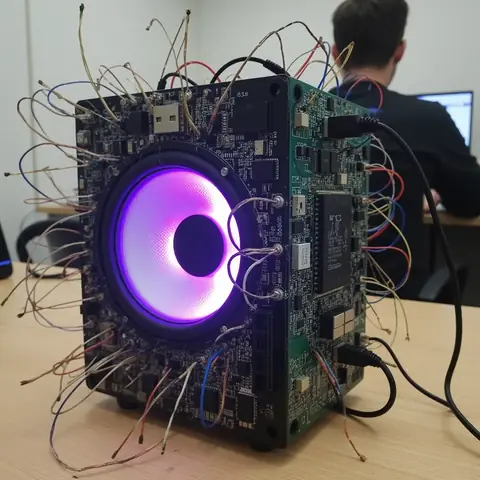
VectraYX-Nano: A New Spanish AI for Cybersecurity
Researchers have created a small but powerful AI model for cybersecurity in Spanish. It's designed to understand and respond to security threats in Latin American contexts.
87 stories tagged Cybersecurity · page 3 of 4

Researchers have created a small but powerful AI model for cybersecurity in Spanish. It's designed to understand and respond to security threats in Latin American contexts.

Researchers have announced that AI models have surpassed all previous benchmarks for autonomous cybersecurity capabilities. This breakthrough could revolutionize how we protect digital systems from threats.

OpenAI has launched Daybreak, a new AI platform designed to help organizations defend against cyber threats. This tool uses advanced AI to identify and mitigate security risks in real-time.

Google has stopped a sophisticated cyberattack developed with AI that aimed to bypass two-factor authentication. This is the first known case of AI being used to create a zero-day exploit for mass exploitation.

A major security flaw called CopyFail has been discovered in Linux, affecting everything from servers to cloud services. Experts are urging immediate action to protect systems.

Anthropic's AI system, Mythos, discovered critical security bugs in Firefox. This could lead to safer web browsing for everyone. Mozilla is now using AI to proactively find and fix vulnerabilities before they become problems.

OpenAI has introduced GPT-5.5 and GPT-5.5-Cyber under its Trusted Access program, aiming to help cybersecurity professionals protect critical infrastructure. This move is designed to accelerate vulnerability research and enhance cyber defenses.

A new open-source AI model is designed to run locally and help detect cyber threats. It's small, specialized, and built for everyday users to protect their devices.

OpenAI is limiting access to its new cybersecurity tool, GPT-5.5 Cyber, to only critical cyber defenders. This follows criticism of Anthropic for restricting its own AI tool, Mythos.

OpenAI is launching GPT-5.5-Cyber, a specialized cybersecurity model reserved for critical cyber defenders. The model will not be available to the public, focusing instead on fortifying institutional defenses.

OpenAI has proposed a comprehensive strategy to bolster cybersecurity using AI, emphasizing democratized defense tools and protection of critical infrastructure. The plan aims to address growing threats in an era of advanced digital warfare.

A recent study revealed five critical AI agent failures over a 36-day period, none of which were detected by the agents themselves. This highlights significant gaps in AI self-monitoring and security protocols.

The Hugging Face Blog highlights how open-source AI is transforming cybersecurity by fostering collaboration and innovation. Transparency in AI models is crucial for building trust and resilience against cyber threats.

A new study reveals previously unknown attack vectors in sandboxed AI agents, challenging assumptions about their security. The findings highlight the need for enhanced isolation techniques and continuous monitoring.

Google's massive investment in Anthropic underscores the intensifying AI arms race. The deal includes both cash and compute resources, following the release of Anthropic's security-focused Mythos model.

A ransomware family has adopted post-quantum cryptography (PQC), making it the first to be quantum-safe. The move, though currently impractical, signals a concerning trend in cybersecurity.

Major tech companies are accelerating their adoption of post-quantum cryptography, but progress remains uneven. This shift is crucial to protect against future quantum computing threats.

Anthropic's tightly controlled rollout of Claude Mythos has been compromised, with unauthorized users gaining access. This incident contradicts the company's claims about the model's security capabilities and potential dangers.

Anthropic's powerful Mythos AI model, intended for cybersecurity, has been accessed by unauthorized users. The breach raises concerns about the misuse of advanced AI tools. The leak occurred through a third-party contractor, highlighting vulnerabilities in AI security protocols.

Researchers tested four methods for identifying authors based on stylistic features in Japanese reviews, aiming to support future dark web actor analysis. The study highlights the potential of BERT-based approaches for authorship attribution.

StegoForge is a new tool that embeds and detects hidden data in files using offline AI. It offers a novel approach to steganography with potential applications in cybersecurity and privacy.

Anthropic's new cybersecurity-focused model, Claude Mythos Preview, could improve its strained relationship with the Trump administration. The administration had previously criticized the company as a national security threat.

OpenAI has introduced GPT-5.4-Cyber, a specialized model for cybersecurity, along with $10M in API grants to bolster global cyber defense. Leading security firms and enterprises are joining OpenAI’s Trusted Access for Cyber initiative.

OpenAI has introduced GPT-5.4-Cyber to its Trusted Access for Cyber program, enhancing AI-driven cybersecurity for vetted defenders. This move underscores the growing importance of advanced AI in cyber defense.