New AI Model EMO Lets You Mix and Match Skills Like Lego Blocks
Researchers have created EMO, an AI model that can learn different skills separately and combine them as needed. This could make AI more flexible and efficient for everyday tasks.
176 stories tagged Machine Learning · page 6 of 8
Researchers have created EMO, an AI model that can learn different skills separately and combine them as needed. This could make AI more flexible and efficient for everyday tasks.
Researchers have developed a new AI framework called LANTERN that helps machines learn new tasks faster by combining knowledge from multiple past experiences. This could make AI systems more efficient and adaptable in real-world applications.
Researchers have developed a new reinforcement learning technique called Adaptive Power-Mean Policy Optimization (APMPO) that improves how AI models reason. This method adapts to the evolving capabilities of large language models, making them more effective at problem-solving.

Researchers have developed ANDRE, a new AI system that extracts logical rules from data more effectively than previous methods. This could make AI systems more interpretable and reliable in real-world, uncertain situations.
Researchers have improved a technique called Emphatic TD (ETD) to make AI learning faster and more stable. This could help AI systems learn more efficiently from real-world experiences.
Researchers created a new test to measure how well AI systems understand cause and effect in messy, real-world data. This could help improve AI's ability to make better decisions in uncertain situations.

Researchers developed a new AI algorithm called FREIA that helps large language models improve their reasoning skills on their own. This could lead to smarter AI assistants that learn and adapt without constant human supervision.
Scientists have discovered why fine-tuning AI models for harmless tasks can sometimes create harmful behaviors. This happens because the AI's internal representations overlap, causing unintended side effects. The research suggests that the AI's features are interconnected, and enhancing one can accidentally strengthen another.
Researchers have developed a new approach called Adaptive Entropy Modulation (AEM) to improve how AI agents learn complex, multi-step tasks. This could make AI assistants better at handling long conversations or tasks with many steps.
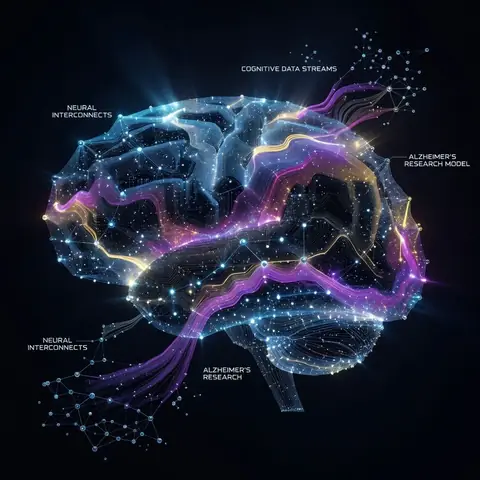
Researchers evaluated TabPFN against traditional machine learning methods for predicting Mild Cognitive Impairment (MCI) to Alzheimer's Disease (AD) conversion. The study found TabPFN performed comparably to traditional models despite limited longitudinal data.

Researchers are studying new methods for AI to update its beliefs more flexibly. These methods could help AI systems adapt to new information more naturally, like humans do.

Researchers used AI to analyze underground rock formations in Ghana's Keta Basin without needing extensive physical samples. This method could make resource exploration more efficient and cost-effective.

Researchers propose a five-agent system that automates ML pipeline generation from datasets and natural-language goals. The architecture improves efficiency, robustness, and explainability in ML workflows.

A new study explores whether fundamental reasoning patterns in LLMs can be decoupled from specific problem instances. The research highlights the challenges and implications for model controllability and reasoning capabilities.
Researchers propose a compositional meta-learning method to improve training efficiency in physics-informed neural networks (PINNs) for parameterized PDEs. This approach addresses task heterogeneity, reducing computational costs and improving adaptability across different tasks.

Researchers introduced OMEGA, an end-to-end framework that automates AI research from idea generation to executable code. The system generated novel ML classifiers that outperformed scikit-learn baselines on 20 benchmark datasets.

DreamProver introduces a novel approach to theorem proving by creating transferable lemma libraries through an iterative wake-sleep process. This method enhances adaptability compared to fixed or overly specific lemma libraries.

Researchers introduce Distill-Belief, a teacher-student framework to address the challenge of closed-loop inverse source localization and characterization. This method aims to balance speed and accuracy in uncertain environments.

A new study reveals that training AI models on power-law distributed data improves their performance on complex reasoning tasks. This challenges the assumption that uniform data distributions are superior for learning rare skills.

A new study formalizes the concept of 'background temperature' to describe implementation-level nondeterminism in large language models. This helps explain why identical inputs can produce divergent outputs even at temperature T=0.
Ineffable Intelligence, founded by former DeepMind researcher David Silver, has secured $1.1 billion in funding. The lab aims to develop AI that learns without relying on human data.

Researchers introduce MolClaw, an autonomous AI agent that excels in drug molecule evaluation, screening, and optimization. The agent uses a three-tier hierarchical skill architecture to unify over 30 specialized tools, addressing key challenges in computational drug discovery.

Hugging Face has ported its Transformers library to MLX, enabling faster AI model inference on Apple Silicon. This move aims to leverage Apple's neural engine for enhanced performance.

Google's Tensor Processing Units (TPUs) are evolving to handle increasingly complex AI workloads. A new video explains how these specialized chips are powering advanced AI applications.