
iOS 27 to Let You Pick Your Favorite AI Models
Apple is planning to allow users to choose which third-party AI models they want to use on their iPhones. This could change how you interact with AI on your device.
155 stories tagged Models · page 6 of 7
Apple is planning to allow users to choose which third-party AI models they want to use on their iPhones. This could change how you interact with AI on your device.

A new study introduces AgentFloor, a benchmark to test how well smaller AI models can handle routine tasks. The goal is to see which parts of AI workflows need big, advanced models and which can be done by smaller ones.

Meta has acquired Assured Robot Intelligence, a humanoid robotics startup, to enhance its AI models for robots. This move underscores Meta's growing interest in physical AI applications beyond virtual environments.

DeepInfra is now part of Hugging Face's Inference Providers, making it easier to deploy AI models. This collaboration simplifies running models for developers and researchers.

A 200-person Chinese team released DeepSeek V4, surpassing models from larger labs. The model achieves state-of-the-art performance on key benchmarks, challenging the dominance of well-funded Western AI labs.

IBM has released Granite 4.1, a suite of open-source large language models trained using advanced techniques like mixture-of-experts and fine-tuning. The models are optimized for both efficiency and performance, setting a new standard in open-source AI.

A new study explores source-modality monitoring in vision-language models, assessing their ability to track and communicate the origin of information. The research evaluates how models bind words to specific input components across 11 different models.

A study reveals that LLMs trained on Western data fail to detect health misinformation in non-Western contexts, such as cow urine remedies on Indian YouTube. This highlights a critical gap in AI's ability to handle culturally nuanced content.

Amazon has quickly integrated OpenAI's latest models into AWS, including a new agent service. This move underscores the intense competition in the AI cloud market. The rapid deployment highlights how quickly tech giants are pivoting to capitalize on OpenAI's newly non-exclusive offerings. It also raises questions about Microsoft's long-term strategy with its AI investments.

NVIDIA showcases Gemma 4's Variable-Length Attention (VLA) running on the Jetson Orin Nano Super. This highlights the model's efficiency and flexibility in edge computing applications.

Alibaba has released Qwen3.6-27B, an open-source model with 27 billion parameters that excels in coding tasks, surpassing its larger predecessor. This model demonstrates significant advancements in agentic coding capabilities.

OpenAI has released GPT-5.5 and GPT-5.5 Pro, offering improved performance and new features. The models are now available through the API, expanding access for developers.
DeepSeek has previewed two new AI models, DeepSeek V4 and DeepSeek V4+, that outperform its previous V3.2 model and significantly close the gap with leading models. The improvements come from architectural enhancements that boost efficiency and performance.

OpenAI has released GPT-5.5, its most advanced model yet, designed for complex tasks like coding, research, and data analysis. The new model is faster and more capable than its predecessors.

OpenAI has released GPT-5.5, its latest AI model, boasting enhanced capabilities across multiple domains. This advancement brings the company closer to realizing its vision of an all-encompassing AI 'super app'.

OpenAI has published the system card for GPT-5.5, detailing its improved performance and safety measures. The model shows significant advancements in reasoning and multilingual understanding.

OpenAI's new ChatGPT Images 2.0 model excels not just in image generation but also in producing coherent text. This marks a significant leap in AI versatility and integration.
Alibaba has released an early preview of Qwen3.6-Max-Preview, showcasing enhanced agentic coding, stronger world knowledge, and improved real-world reliability. This model represents a significant leap forward in AI capabilities.

Kimi K2.6 sets new standards in open-source coding with top-tier performance across multiple benchmarks. The model excels in long-horizon coding tasks, handling up to 4,000 tokens.

The 2026 AI stack highlights the leading models and tools shaping the industry. This edition includes major players like OpenAI, Anthropic, and new entrants like Mistral AI.

Developers are prioritizing model size over efficiency, leading to higher costs and reduced productivity. This trend highlights a growing disconnect between perceived and actual performance gains.

OpenAI has introduced GPT-5.4-Cyber, a specialized model for cybersecurity, along with $10M in API grants to bolster global cyber defense. Leading security firms and enterprises are joining OpenAI’s Trusted Access for Cyber initiative.

Anthropic has released Claude Opus 4.7, its most powerful generally available model yet. The update enhances capabilities in software engineering, image analysis, and instruction following. This launch comes amid growing anticipation for the upcoming Mythos Preview.
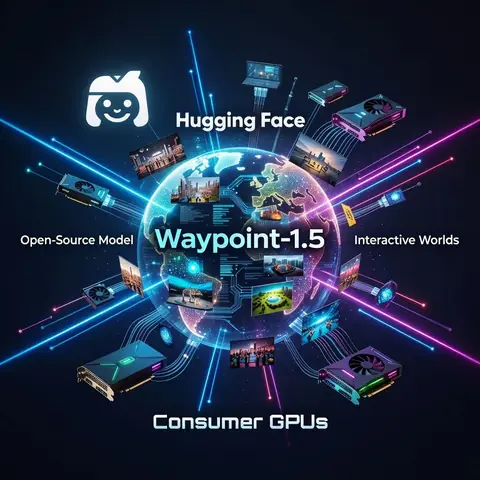
Hugging Face has released Waypoint-1.5, an open-source model designed to generate high-fidelity interactive worlds that run efficiently on consumer-grade GPUs. This release lowers the barrier to entry for developers building immersive, real-time 3D environments without requiring massive enterprise infrastructure.