AI Model Design Unveils Interstellar Mission Trajectory as OpenAI Cuts Off Cursor and Previews AGI Milestones
Summarized by AI from reporting by Peter H. Diamandis, published under our editorial policy.
Episode 285 of the Moonshots podcast detailed the AI-calculated Fermi Explorer interstellar probe, OpenAI's API termination for SpaceX-owned Cursor, and new milestones in AI chip design.
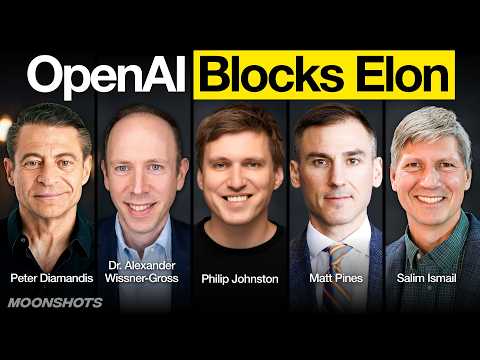
During the latest episode of the Moonshots podcast, StarCloud CEO Philip Johnston and Physical Super Intelligence (PSI) co-founder Matt Pines announced the Fermi Explorer mission, a proposed $15 million project to launch a probe toward Alpha Centauri within three years. Designed using PSI's open-source physics AI framework, the spacecraft's path relies on a counterintuitive "perihelion pump maneuver," firing retrograde burns to draw the satellite close to the sun before accelerating via the Oberth effect. Utilizing standard xenon ion thrusters and a 100-kilogram mass frame, the project highlights how multi-agent AI systems are collapsing multi-year aerospace engineering studies into days of automated compute.
The podcast also addressed rising friction among leading AI developers following OpenAI's decision to cut model support for Cursor, the AI coding workspace recently acquired by SpaceX for $60 billion. OpenAI cited contract violation concerns and potential exposure of proprietary reasoning traces to SpaceX, prompting Anthropic to step in and offer its Claude models to Cursor users. Simultaneously, OpenAI executives reiterated predictions that internal models like Astra—which demonstrated 16 coordinated agents solving research-level mathematics—could meet internal benchmarks for artificial general intelligence before the end of the year.
Custom Silicon and Business Model Shifts
In hardware innovation, Palo Alto startup Architect Labs introduced Redwood, described as the first microchip designed entirely by AI from a high-level spec without human layout intervention. Developed in two weeks, the chip achieved zero bugs on first silicon while yielding 3.4 times the performance per watt of Nvidia's Jetson platform. The episode concluded with a look at AI commercialization, where major providers like OpenAI and Salesforce are transitioning from per-token billing to outcome-based pricing models that charge enterprises only upon successful task completion.