Jensen Huang Defends Escalating AI Capex, Outlining Growth in Physical AI and Global Infrastructure
Summarized by AI from reporting by Bg2 Pod, published under our editorial policy.
In a wide-ranging discussion, Nvidia CEO Jensen Huang addressed concerns over AI infrastructure spending, citing insatiable demand driven by agentic reasoning, physical AI, and broad enterprise adoption. Huang also detailed Nvidia's safety frameworks and highlighted future compute frontiers, including potential space-based data centers.
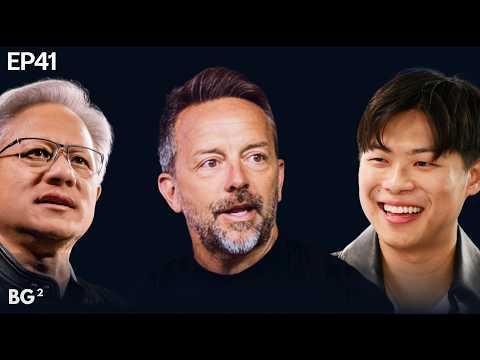
Addressing persistent questions about whether enterprise AI revenues justify massive capital expenditure, Nvidia CEO Jensen Huang emphasized that compute demand extends far beyond a small group of frontier labs. Speaking in a recent interview, Huang outlined how the industry's pivot toward multi-step reasoning, agentic tool use, and complex search-space exploration requires vastly more compute power than earlier generative models. He dismissed fears of an immediate infrastructure bubble, noting that Nvidia's growth is distributed across classical data processing, vertical domain models, physical AI, and thousands of emerging startups leveraging open-source foundation models.
Huang highlighted that physical bottlenecks—including land acquisition, power generation, permitting, and specialized construction labor—represent the primary constraints to scaling AI data centers over the next several years. To navigate these limitations, Nvidia is expanding its hardware footprint into high-efficiency CPUs, networking, and full-stack software solutions. Notably, Huang revealed that Nvidia engineering teams are collaborating with SpaceX to design high-density server architectures tailored for launch on Starship, aiming to deploy high-value compute payloads directly into orbit to overcome terrestrial energy limits.
On safety and governance, Huang argued that AI security and capability are fundamentally unified engineering tasks rather than opposing forces. Rejecting existential 'doomer' narratives, he advocated for strict containment strategies based on zero-trust principles and continuous out-of-band monitoring, highlighting Nvidia's Open Shell framework. Reflecting on recent White House accords, Huang expressed confidence that government coordination and industry-led safety practices will ensure superintelligence is deployed safely across manufacturing, healthcare, and national infrastructure.