Is AI a Bubble? Read on Risk Tracks What Top Investors Actually Think
Summarized by AI from reporting by Read on Risk, published under our editorial policy.
Read on Risk, a sister site of AInformed, turns what top investors and podcasters say into a daily sentiment index on AI, markets and crypto. On October 29, 2026 its AI consensus read risk-on, while views on AI capex were split.

Key takeaways
- Read on Risk, a sister site of AInformed, tracks what a hand-picked set of investors and podcasters say about AI, markets and crypto, with every claim linked to its source.
- On October 29, 2026, Read on Risk's AI consensus index stood at +83 (risk-on), with all six voices it follows leaning bullish.
- Read on Risk's AI capex views were split one bullish to two bearish, with financing and overbuild risk as the main worry.
- Read on Risk checks quotes against transcripts in code and calculates its consensus index arithmetically, with each voice counting once.
- Read on Risk reports what others said and gives no investment advice.
Is AI a bubble? It's the question hanging over every earnings call and data-center announcement, and the answer you hear depends on which investor you happen to listen to. Read on Risk, a sister site of AInformed run by the same owner, tries to answer it differently: it follows a hand-picked set of investors and podcasters, reads every new episode, and turns what they say into a daily measure of market sentiment on AI, markets and crypto, with every claim linked back to the moment it was said. Everything below comes from Read on Risk's own pages as of October 29, 2026; it is a summary of what other people said, not investment advice.
What top investors are saying about the AI bubble
Read on Risk's AI sentiment tracker currently puts the consensus firmly risk-on, at +83 on its scale from -100 to +100, with all six voices it follows leaning bullish. Its summary of the week: most voices see AI demand outrunning supply, with strain expected mainly among over-leveraged builders.
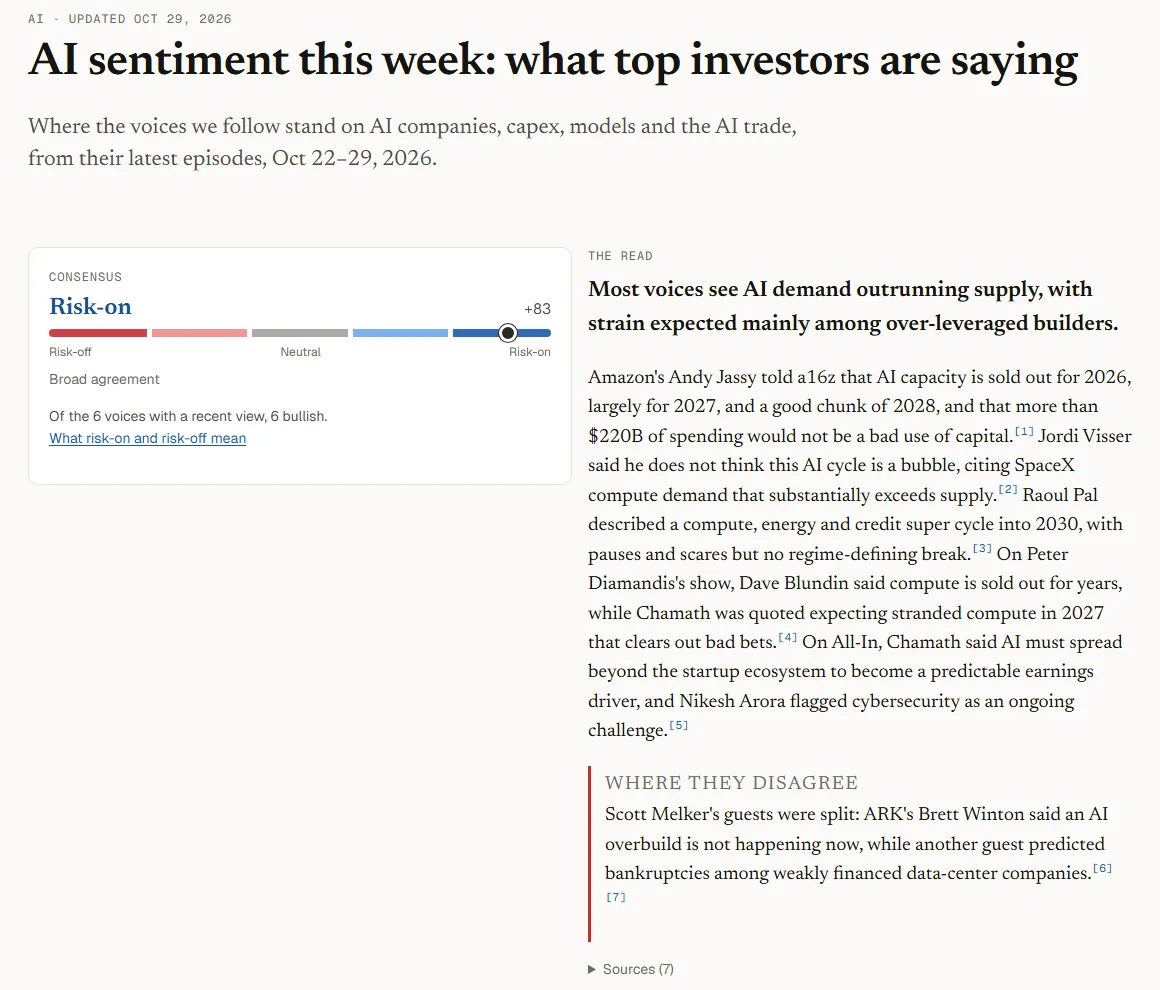
The individual views are where it gets useful. According to the site, Amazon's Andy Jassy told a16z that AI capacity is sold out for 2026 and largely for 2027, and that more than $220 billion of spending would not be a bad use of capital. Jordi Visser said he does not think this AI cycle is a bubble. Raoul Pal described a compute, energy and credit "super cycle" running into 2030, with pauses and scares along the way. That lines up with AInformed's recent coverage of Jensen Huang defending rising AI capex and of the argument that hedge-fund deleveraging, not an AI bubble, is behind recent volatility.
Where the bubble worries actually sit: AI capex
A bullish headline number can hide real disagreement, and Read on Risk surfaces it rather than averaging it away. On its page tracking what investors are saying about AI capex, the latest views run one bullish to two bearish: the worry isn't whether demand exists, but whether the financing behind the build-out holds up.
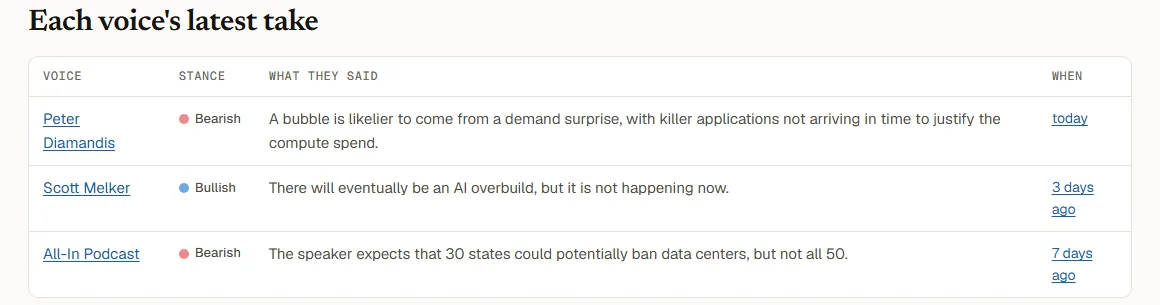
On Peter Diamandis's show, a guest argued a bubble is likelier to come from a demand surprise, with killer applications arriving too late to justify the compute already being built. On the All-In Podcast, a guest suggested as many as 30 US states could move to ban data centers. Scott Melker's guest, ARK's Brett Winton, took the other side: an AI overbuild will come eventually, he said, but it is not happening now. Read on Risk also notes Brent Donnelly's view, on Melker's show, that the market is shifting from believing AI spending will pay back to doubting it.
How the consensus index is calculated
The part that sets Read on Risk apart from a headline aggregator is its method, which it documents in full. The site explains how the consensus index is calculated: each day it checks every followed show for new episodes, works from captions or transcripts, and has a language model record each episode's stance on markets, AI and crypto on a five-point scale, along with specific claims and predictions.
Code then checks the model's work. Quotes are kept only if they match the transcript word for word and run 25 words or fewer, and timestamps outside the episode are dropped. The index itself is arithmetic, not model output: stances from the last 45 days are weighted by conviction and recency (halving every 14 days), and each voice counts once, so a daily show can't outvote a weekly one.
Beyond AI: markets and crypto sentiment
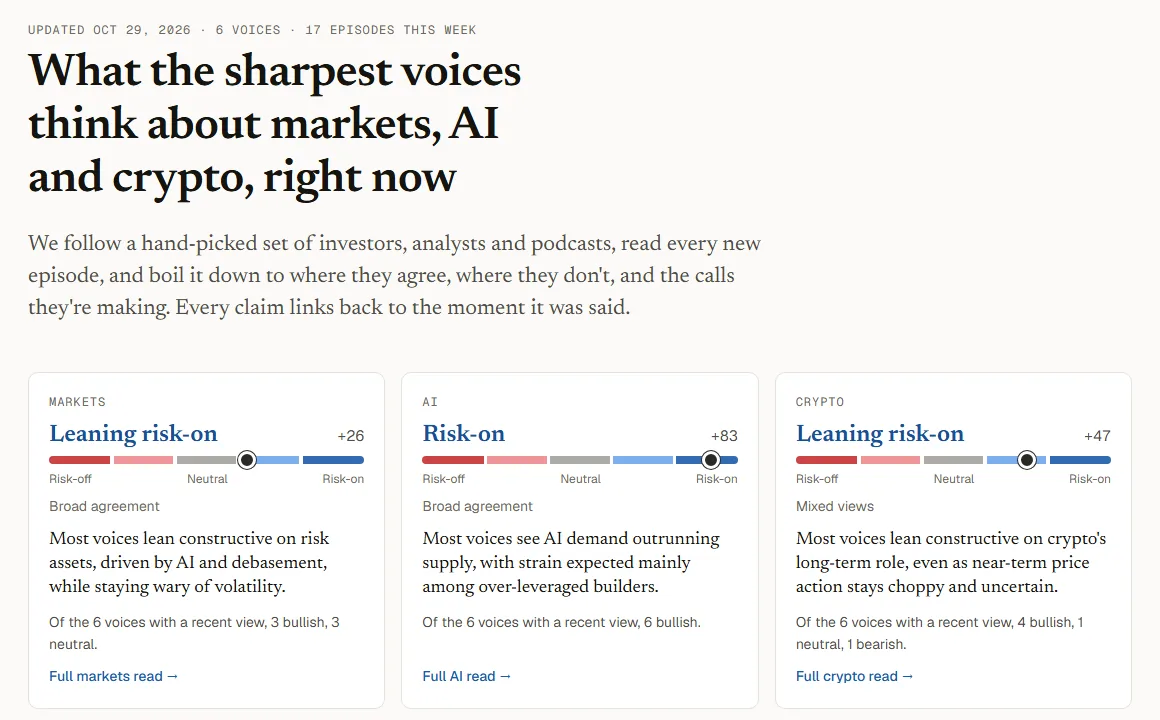
AI is one of three tracks. On October 29 the homepage showed markets leaning risk-on at +26, up from +13 the week before, and crypto leaning risk-on at +47, with views more mixed than on AI. If the terms are new, the site's explainer on risk-on vs risk-off covers what they mean and which assets tend to move together in each phase.
How to use it, and what it isn't
Read on Risk is upfront that it has no view of its own and gives no advice. Its summaries are generated by AI and checked in code, but they can still misread sarcasm, hypotheticals or numbers, so the sensible way to use it is as a map: see where the people you'd otherwise have to listen to for hours agree and disagree, then click through to the exact moment a claim was made before relying on it. The current consensus is also available as JSON and RSS, and as a plain-text summary for AI assistants.
Frequently asked
- Is AI a bubble, according to top investors?
- Most of the investors Read on Risk follows said no as of October 29, 2026: its AI consensus read risk-on at +83, though views on AI capex specifically were split, with financing risk the main concern.
- What is Read on Risk?
- Read on Risk is a site that reads new episodes from a hand-picked set of investors and podcasters and summarizes where they stand on markets, AI and crypto, with a daily consensus index and links to every source.
- How does Read on Risk calculate its sentiment index?
- A language model records each episode's stance on a five-point scale; code then weights stances from the last 45 days by conviction and recency, counts each voice once, and converts the result to an index from -100 (risk-off) to +100 (risk-on).
- Is Read on Risk investment advice?
- No. It reports what other people said in public and states that nothing on the site is financial advice or a recommendation to buy or sell.