Raoul Pal and Andreas Argue Market Is Mispricing AI Infrastructure Stocks
Summarized by AI from reporting by Raoul Pal The Journey Man, published under our editorial policy.
Macro investor Raoul Pal and analyst Andreas discuss why major AI hardware and foundational model providers are undervalued relative to legacy equities. They argue that tight liquidity and macro factors—rather than deteriorating fundamentals—are driving market skepticism.
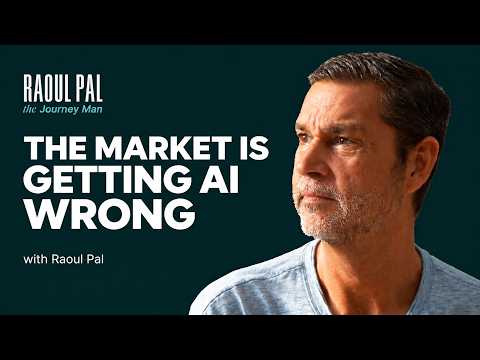
In a recent discussion on The Journey Man, host Raoul Pal and market analyst Andreas addressed what they view as a significant market mispricing of artificial intelligence equities. Andreas noted that essential AI supply-chain companies—including Nvidia, TSMC, Micron, and foundational labs like Anthropic—are currently trading at forward price-to-earnings multiples far below traditional defensive stocks like Walmart and Costco. While traditional portfolio managers express caution over potential compute overcapacity, both speakers argued that fundamental demand for AI compute continues to outstrip available supply across both training and inference workloads.
Pal rejected the argument that tech infrastructure buildouts will inevitably end in oversupply, describing AI compute as a market driven by virtually infinite demand. Lower costs per unit of intelligence expand usage rather than destroy margins, creating a feedback loop where more compute leads to more autonomous agents and higher demand. Pointing to firms like Anthropic and CoreWeave, the speakers noted that AI companies are generating cash flows quickly enough to self-fund expansion, contradicting bearish assumptions about GPU depreciation and hardware obsolescence.
Rather than failing business models, Pal and Andreas attributed recent stock volatility to broader macroeconomic headwinds, including a strong U.S. dollar, tight credit spreads, and high energy prices that have constrained fund liquidity. Comparing platforms like Claude to operating systems of the 1990s, they contended that as AI tools continue driving enterprise productivity, software workflows will consolidate around intelligence layers once global financial conditions normalize.