
Thousand Token Wood: A Mini AI Economy Runs on a Tiny Model
Researchers built a multi-agent economy simulation using a small AI model with just 3 billion parameters. This shows how powerful even modest-sized models can be for complex tasks.
1854 stories tagged AI · page 48 of 78
Researchers built a multi-agent economy simulation using a small AI model with just 3 billion parameters. This shows how powerful even modest-sized models can be for complex tasks.

OpenAI has released a comprehensive plan to use AI for biological threat detection and response. This initiative aims to make biodefense more proactive and efficient for everyone.

At its developer conference, Nvidia's Jensen Huang described a completely new way of using laptops, powered by AI that anticipates your needs and adapts to your workflow. This could make computers feel more like intuitive personal assistants than traditional tools.

Researchers have proposed a new motivational architecture for AI that focuses on conversational agents. The architecture reinterprets the OpenPsi motivational lineage for linguistic interactions, aiming to make future AI assistants more engaging and responsive to human mental states.
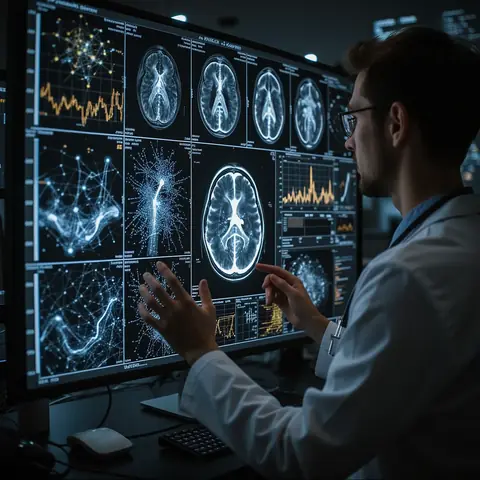
Researchers developed an AI system that predicts knee pain from MRI scans with high accuracy. The framework combines deep learning and statistical modeling to make the results interpretable and trustworthy.

Google is paying SpaceX a staggering $920 million per month for computing power to support its AI products. This deal highlights the massive demand for advanced AI infrastructure.

Researchers developed a method called GITCO to improve AI forecasting by cleaning up the input data instead of changing the model itself. This could make AI predictions more accurate without needing to retrain the model.

Apple’s Worldwide Developers Conference (WWDC) 2026 is expected to feature a revamped Siri and new Apple Intelligence tools. These updates aim to make Apple’s ecosystem smarter and more integrated for everyday users.

AirTrunk, an Australian data center operator, is investing $30 billion to build 5 gigawatts of AI-focused data centers in India. This massive project will significantly boost India's AI infrastructure and global tech competitiveness.

When AI models edit code repeatedly, they tend to recycle the same solutions rather than exploring new ones. This could limit how creative AI tools can be when helping programmers. Researchers found that in 87% of mutation chains, over 93% of AI-generated code mutations revisited familiar structural forms.

Donald Trump suggested the US government could take ownership stakes in AI companies to ensure national security. This would be a major shift in how the US engages with the tech industry.

Researchers introduced SentinelBench, a benchmark to test AI agents' ability to monitor tasks over long periods. This could improve AI assistants that handle slow, real-world tasks like waiting for stock price changes or tracking delivery updates.

Scientists studied how AI agents communicate and found that unstructured chatting wastes resources. They discovered that structured communication can make AI teams work faster and cheaper.

Researchers introduced Agents' Last Exam (ALE), a new benchmark to evaluate AI agents on long-horizon, economically valuable tasks with verifiable outcomes. This could help bridge the gap between AI performance in labs and real-world usefulness.

Researchers created a synthetic dataset to help AI understand complex questions across multiple tables. This could make databases and spreadsheets much easier to query with natural language.

Researchers developed a new AI system called Query Retrieve Conclude that can understand and interpret memes by finding missing context online. This could help platforms moderate content and users better understand internet humor.

Researchers introduced LeanMarathon, a multi-agent AI system designed to help mathematicians formalize and prove complex theorems in the Lean proof assistant. It uses four contract-scoped agents to construct, audit, prove, and repair an evolving blueprint that serves as a formal proof skeleton, natural-language proof graph, and shared system of record, addressing issues like statement drift, tangled dependencies, and context decay.

Poke, an AI agent startup, is now the first approved for Apple’s Messages for Business platform. This means businesses can now use AI to handle customer inquiries via text messages on iPhones.

Researchers discovered that AI judges used to rank model performance can be swayed by follow-up conversations after they have already made a decision. This vulnerability, called 'post-decision manipulability,' challenges the reliability of current AI evaluation methods.

Wasmer leveraged OpenAI's Codex, powered by GPT-5.5, to create a Node.js runtime for edge devices, speeding up development 10x to 20x. This breakthrough showcases how AI can accelerate software development for edge computing.

The UK's Competition and Markets Authority (CMA) has ordered Google to allow publishers to opt out of AI Search features. This gives website owners more control over how their content is used in AI-generated summaries and overviews.

Taiwan Semiconductor Manufacturing Co. (TSMC), the world's largest chip maker, is struggling to meet the surging demand for AI chips. Even with new factories in the US, supply can't keep up with the explosion in AI development. This bottleneck could slow down AI progress for everyone.

Major AI companies, including fierce rivals, have united to warn lawmakers about the risk of AI being used to develop biological weapons. They're calling for stricter regulations to close what they describe as an alarming biosecurity gap.

Researchers propose a way to test AI agents before they go live, ensuring they follow rules, stay safe, and comply with governance standards. This addresses a critical gap in enterprise AI reliability.