
New AI Tool Tests Trading Bots in Realistic Financial Scenarios
Researchers created OpenFinGym, a platform to test AI trading bots on multiple financial tasks. It helps evaluate how well these bots perform in real-world market conditions.
2101 stories tagged AI · page 46 of 88
Researchers created OpenFinGym, a platform to test AI trading bots on multiple financial tasks. It helps evaluate how well these bots perform in real-world market conditions.

Researchers have developed HierBias, an AI model that analyzes whole articles to detect media bias, formally proving that using document context reduces error compared to sentence-by-sentence approaches.

Researchers created a contamination-aware, multi-zone benchmark called Know2Guess to evaluate when large language models should answer questions versus abstain. It has 1,200 items across five domains with explicit abstention expectations and contamination-risk metadata.

Researchers found that AI models like GPT-5.1, Gemini 3 Pro, and DeepSeek-V3.2 have distinct tendencies when suggesting research methods. The study highlights how these models might influence scientific research differently.

Researchers introduced COrigami, an AI pipeline that co-designs origami crease patterns which are both mathematically flat-foldable and visually recognizable. This bridges the gap between rigid geometric constraints and subjective aesthetics, potentially making computational origami design more accessible.

Researchers introduced ContextForge, a system that helps large language models maintain relevant information across long conversations by recycling context instead of replaying entire histories. This could slash token usage and improve multiturn reasoning.

Researchers developed an AI system that combines official drug data with patient experiences to provide safer, more accurate medication information. This could help people make better decisions about their mental health treatments.

Researchers have developed AlgoEvolve, an AI system that uses large language models to evolve and improve algorithmic trading strategies. This could make trading more accessible and efficient for everyday investors.

A new AI model called iLLaDA uses a different approach to understand language, potentially making it more efficient and accurate. This could lead to better AI assistants and tools that understand context more naturally.

NVIDIA's new NeMo AutoModel makes customizing AI models faster and easier. It automates the fine-tuning process, which could help businesses and developers create specialized AI tools without needing deep technical expertise.

CtxGov is a new open-source tool that reveals the hidden instructions behind AI agents. It helps users understand how their AI assistants make decisions. This transparency could change how people trust and use AI tools.

A new practitioner's reference, 'The Hitchhiker's Guide to Agentic AI,' covers the full stack of building autonomous AI systems—from transformer architecture and GPU systems to fine-tuning, model compression, and production deployment.

Researchers developed an AI technique to automatically create highlights for academic papers. This could make scientific research easier to digest for non-experts and improve literature searches.

A small group of Wikipedia editors has shown that targeted edits can influence how AI models discuss animal welfare. Their work highlights the power of curated information in shaping AI behavior.
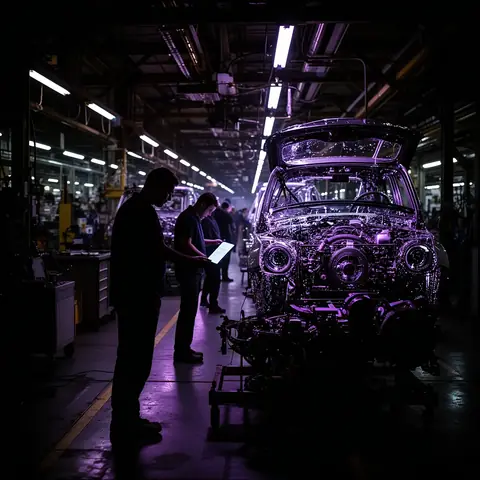
Ford is bringing back 350 quality inspectors after AI tools failed to capture their expertise or train new employees effectively. This highlights the challenges of replacing human knowledge with automation in complex fields.

A former Databricks AI chief has unveiled Un-0, an image-generation system that could slash AI power consumption by up to 1,000 times, making AI more accessible and environmentally friendly.

Anthropic's Claude is attracting more paying users, even as ChatGPT dominates the overall AI market. This shift suggests a growing preference for Claude's features among those willing to pay for AI services.

Anthropic claims Alibaba attempted to access its AI model, Claude, through deceptive means. This highlights growing tensions in the competitive AI industry.

Researchers developed a method using large language models to automatically generate challenging test problems for AI reasoning. This could lead to better evaluations of AI's ability to apply knowledge to new, harder tasks.

AI systems are now authorized to prescribe medications independently in the U.S. This shift raises critical questions about trust, liability, and how to handle uncertainty in medical decisions. Researchers highlight gaps in current regulations that could impact patient safety.

AI memory benchmarks often hide key details, making it hard to compare models fairly. This lack of transparency affects how we evaluate AI capabilities.

The Washington Post tested major AI chatbots to see if they show political bias. The results show some differences in how they respond to political topics, but none were strongly biased overall.

SpaceX has signed a massive deal with open-source AI lab Reflection AI for AI computing power. This partnership will give Reflection AI access to cutting-edge hardware for developing advanced AI models.

Qualcomm is buying AI startup Modular for $4 billion to strengthen its AI software capabilities. This deal highlights the growing importance of AI in mobile technology and everyday devices.