
DeepMind Introduces AI Co-Clinician to Transform Healthcare
DeepMind has unveiled an AI co-clinician designed to assist healthcare professionals. This innovation promises to enhance diagnostic accuracy and streamline patient care.
121 stories tagged Healthcare · page 5 of 6
DeepMind has unveiled an AI co-clinician designed to assist healthcare professionals. This innovation promises to enhance diagnostic accuracy and streamline patient care.
Recent studies show AI models achieving higher accuracy in medical diagnoses than human doctors. This shift could revolutionize healthcare delivery and decision-making.

A new study evaluated 72 large language models on safety for robotic health attendants, finding a 54.4% average violation rate. The results highlight significant risks in deploying LLMs for medical applications without rigorous safety protocols.
A Harvard-led study found AI systems diagnosed emergency cases more accurately than human doctors. The results could revolutionize emergency room efficiency and patient outcomes.

A new study identifies flaws in how LLMs handle clinical trial data, proposing a hybrid approach to improve reasoning. The research focuses on recovering implicit attributes from partially observed tables.
Researchers introduce a lightweight retrieval-augmented generation (RAG) framework to improve patient-trial matching. The approach balances scalability and efficiency with the ability to handle complex EHR data and eligibility criteria.

A team of AI researchers discovered 38 critical vulnerabilities in OpenEMR, software used by 100,000 healthcare providers. The findings highlight the urgent need for better security in open-source medical systems.

A new report reveals that three-quarters of US health systems have adopted AI, but only 18% have implemented governance frameworks. This highlights a critical gap in oversight and accountability.

Researchers propose a novel multi-agent system for personalized physiotherapy, combining generative AI and computer vision to improve at-home rehabilitation. The framework offers real-time feedback and dynamic adjustments tailored to individual patients' needs.
Researchers introduce HypEHR, a hyperbolic model for EHRs that leverages the natural geometry of medical data. This approach promises more efficient and accurate question answering in clinical settings.

A new study compares how different FHIR data serialization formats affect LLM performance in medication reconciliation tasks. The findings highlight significant differences in accuracy across serialization methods.

Researchers developed an AI model using LightGBM and multi-modal feature engineering to detect dosing errors in clinical trial narratives. The system achieved 92% accuracy by combining traditional NLP, semantic embeddings, and medical patterns.

OpenAI has announced that ChatGPT for Clinicians is now free for verified U.S. physicians, nurse practitioners, and pharmacists. This move aims to enhance clinical care, documentation, and research in the healthcare sector.
An AI-driven startup has successfully overturned thousands of denied health insurance claims. The company leverages machine learning to analyze claim denials and identify grounds for appeal, with notable support from Mark Cuban.

DeepER-Med introduces AI agents that enhance evidence-based medical research by improving transparency and trustworthiness. The system integrates multi-hop information retrieval and reasoning to accelerate scientific discovery while mitigating errors.

Researchers developed a model that learns from radiologists' gaze patterns and diagnostic workflows. This approach improves X-ray interpretation by aligning with expert reasoning processes.

Researchers introduce ReSS, a hybrid framework that merges symbolic and neural models to improve tabular data prediction. The approach aims to enhance both accuracy and human-understandable reasoning in high-stakes domains like healthcare and finance.

A new survey and benchmark reveal that while large language models excel at medical exams, their clinical reasoning falls short. The study underscores the need for robust medical reasoning capabilities in real-world healthcare settings.

OpenAI's ChatGPT is being adopted by healthcare professionals for diagnosis, documentation, and patient care. The tool is designed to be HIPAA-compliant, ensuring secure handling of sensitive medical data.
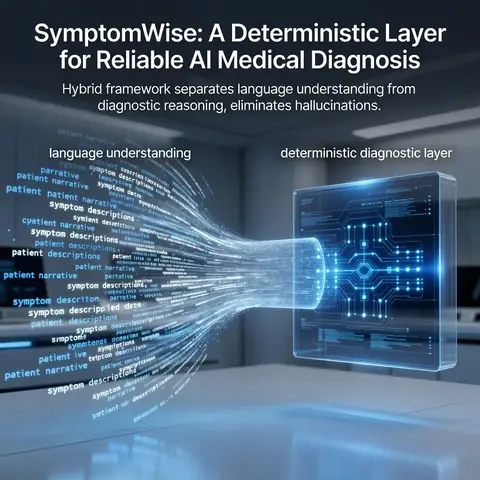
SymptomWise introduces a hybrid framework that separates language understanding from diagnostic reasoning to eliminate hallucinations in AI symptom analysis. By combining expert-curated knowledge with deterministic inference, the system ensures traceable and consistent outputs in safety-critical settings.
Researchers developed an LLM-based tool to identify HIV-related stigma in clinical narratives, addressing a critical gap in healthcare documentation. The tool could improve mental health outcomes and treatment adherence for people living with HIV.

Researchers introduce Keys to Knowledge (K2K), a framework that enhances LLM reliability in healthcare by using internal memory instead of external knowledge bases. This reduces latency and hallucinations in clinical settings.

Google AI is launching a new initiative to improve heart health outcomes in remote Australian communities. The project uses AI to enhance early detection and treatment of cardiovascular diseases.

A new study leverages AI to analyze 400,000 Reddit posts, uncovering previously underreported side effects of GLP-1 weight loss drugs. This approach demonstrates how social media mining can accelerate pharmacovigilance beyond traditional clinical trials.