#multi-agent

Multi Agent

43 stories tagged Multi Agent

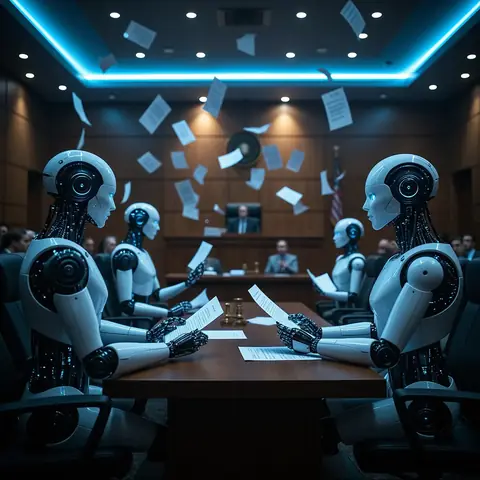
A diagram illustrating the interaction between two AI agents with opposing goals.
research

Experience Orchestrator (EO): A Control-Theoretic Governance Layer That Prevents Conversational Collapse Between Opposing AI Agents

Researchers introduced the Experience Orchestrator (EO), a control-theoretic governance layer that prevents conversations between AI agents with opposing goals from collapsing. Tested in a simulated financial services environment, the EO successfully kept interactions productive where ungoverned conversations fail.

Semantic Cooperative Games: A New Method for Contribution Attribution in LLM-Based Multi-Agent Systems
research

Semantic Cooperative Games: A New Method for Contribution Attribution in LLM-Based Multi-Agent Systems

Researchers introduce Semantic Cooperative Games, a novel framework for fairly attributing contributions in LLM-based multi-agent systems. Unlike existing counterfactual methods that are inefficient and high-variance, this approach explicitly models intermediate semantic states to accurately credit each agent's work in collaborative AI workflows.

MAPS: New AI Framework Lets Agents Hold Conversations While Keeping Their Own Perspectives
research

MAPS: New AI Framework Lets Agents Hold Conversations While Keeping Their Own Perspectives

Researchers introduced MAPS (Multi-Agent Perspective Spaces), a framework that enables multiple AI agents to maintain individualized beliefs, emotions, and cognitive styles during dialogue, avoiding the semantic uniformity of current systems. It uses domain-weighted profiles, GRU-based memory, and token-level attention for interpretable, diverse interactions.

New Research Reveals Hidden Influences in AI Group Discussions
research

New Research Reveals Hidden Influences in AI Group Discussions

Scientists have uncovered how AI agents influence each other during group discussions, revealing a hidden 'herd effect' that shapes group decisions. The study models how AI agents balance their own internal beliefs with the pull of the group, akin to human social dynamics. This discovery could improve how AI systems make decisions by better mimicking human behavior and could lead to more reliable multi-agent AI systems.