New Research Unlocks How AI 'Thinks' in Hidden Layers
Scientists have found a way to make AI reasoning more transparent by treating it like a moving object in space. This could help us understand how AI makes decisions in complex tasks.
8 stories tagged Interpretability

Scientists have found a way to make AI reasoning more transparent by treating it like a moving object in space. This could help us understand how AI makes decisions in complex tasks.

Researchers have developed a new method to uncover the underlying causes of AI decisions in cyber-physical systems. This approach provides more robust insights, helping users understand automated decisions, especially in high-risk domains.

Neuronpedia is an open-source platform that makes AI models more transparent by visualizing their inner workings. It helps researchers and developers understand how AI systems make decisions.

Researchers have developed ANDRE, a new AI system that extracts logical rules from data more effectively than previous methods. This could make AI systems more interpretable and reliable in real-world, uncertain situations.

A new arXiv paper introduces perturbation-based attribution analysis to study how different fine-tuning strategies impact LLMs' interpretive behaviors for automated code compliance. The research highlights significant differences across full fine-tuning, LoRA, and quantized LoRA methods.

A new position paper challenges the prevailing view of LLM reasoning as a chain of thought, proposing instead that it should be studied as latent-state trajectory formation. This shift could redefine how we evaluate and interpret AI reasoning.

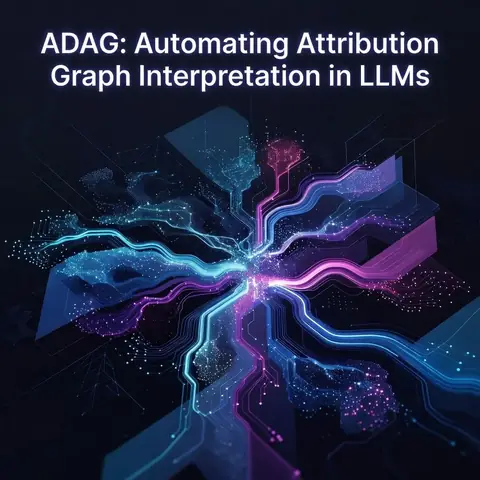
Researchers introduce ADAG, a new pipeline that automatically describes attribution graphs in language models, eliminating the need for manual circuit tracing. This shift promises to scale interpretability research by replacing ad-hoc human inspection with automated analysis.

Large reasoning models perform well on multi-step tasks but have unstable behavior. Step-Saliency analysis reveals information-flow failures.