
OMLX Brings Optimized LLM Inference to Mac Users
OMLX is a new tool designed to optimize large language model inference specifically for Mac users. It promises to make running LLMs on Apple Silicon faster and more efficient.
261 stories tagged LLMs · page 11 of 11
OMLX is a new tool designed to optimize large language model inference specifically for Mac users. It promises to make running LLMs on Apple Silicon faster and more efficient.

Researchers propose a novel framework treating LLM hallucinations as output-boundary misclassification errors, introducing a composite abstention architecture. This system combines instruction-based refusal with a structural gate that blocks unsupported claims based on a calculated support deficit score.

Researchers developed an LLM-based tool to identify HIV-related stigma in clinical narratives, addressing a critical gap in healthcare documentation. The tool could improve mental health outcomes and treatment adherence for people living with HIV.

Netflix has implemented a large language model to evaluate and generate show synopses, improving content discovery. This marks a significant step in AI-driven content curation for streaming platforms.

Researchers propose a framework using LLMs to validate and restructure unsupervised text clusters, improving coherence and reducing redundancy. The method leverages LLMs as semantic judges rather than embedding generators.

Researchers introduce Keys to Knowledge (K2K), a framework that enhances LLM reliability in healthcare by using internal memory instead of external knowledge bases. This reduces latency and hallucinations in clinical settings.

Hugging Face has released TRL v1.0, a comprehensive library designed to streamline post-training workflows for large language models. This update unifies Reinforcement Learning from Human Feedback (RLHF) and other alignment techniques under a single, modular framework.
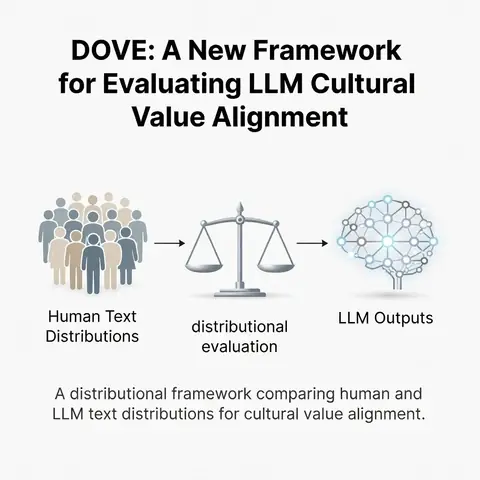
Researchers introduce DOVE, a distributional evaluation framework that compares human text distributions with LLM outputs to assess cultural value alignment. This method overcomes the limitations of traditional multiple-choice benchmarks by addressing the C3 challenge of context, composition, and subcultural heterogeneity.

Researchers introduce DFR-Gemma, a method to integrate dense geospatial embeddings directly with LLMs, enhancing geospatial intelligence. This approach avoids redundancy and token inefficiency in existing systems.

Researchers propose Byte-Level Distillation (BLD) to simplify cross-tokenizer distillation for LLMs. This method operates at the byte level, avoiding complex heuristic strategies.
Researchers introduce ADAG, a new pipeline that automatically describes attribution graphs in language models, eliminating the need for manual circuit tracing. This shift promises to scale interpretability research by replacing ad-hoc human inspection with automated analysis.
Researchers propose a new approach to sequential clinical diagnosis using uncertainty-guided latent diagnostic trajectory learning. This method addresses the challenge of learning effective diagnostic trajectories under uncertainty.
ReVEL is a hybrid framework that uses large language models for iterative reasoning in combinatorial optimization. It embeds LLMs within an evolutionary algorithm to improve heuristic design.

Researchers challenge the notion that supervised finetuning memorizes while reinforcement learning generalizes. They find that cross-domain generalization is conditional, influenced by optimization, data, and model capability. This challenges prevailing narratives in LLM post-training.

ProofSketcher combines LLMs with a lightweight proof checker for reliable math and logic reasoning. It aims to address the limitations of LLMs in producing persuasive but flawed arguments.
Pramana is a novel approach that teaches large language models explicit epistemological methods to improve their reasoning. This approach aims to address the epistemic gap in AI, where models struggle with systematic reasoning and often produce unfounded claims.

Researchers found that surface heuristics can override LLM reasoning constraints. This discovery has significant implications for AI development and trust.
An API catches errors in LLM responses. It helps identify confidently incorrect answers.
A large language model was connected to an 8-bit shoot-'em-up game, receiving structured text summaries instead of traditional inputs. The model developed strategies and discovered an exploit in the game's AI.
A C++ LLM inference engine from scratch has output tokens costing 5x more. The article explores the reasons behind this increased cost.
DeepSeek's latest model, R3, has set new records on AIME and HumanEval, outperforming GPT-5 and Gemini 2.5 Pro on multi-step reasoning tasks while remaining fully open-weights.