
AI Debate System Generates New Scientific Hypotheses
Researchers created an AI system that debates scientific ideas to generate new hypotheses. This could speed up discoveries in fields like battery research by combining fragmented knowledge.
1204 stories tagged Research · page 34 of 51
Researchers created an AI system that debates scientific ideas to generate new hypotheses. This could speed up discoveries in fields like battery research by combining fragmented knowledge.

Researchers created SciAtlas, a knowledge graph that organizes scientific research to help AI and humans find connections. It aims to solve the problem of too much fragmented academic information.
A new study shows how easily safety measures in AI models from Meta and Google can be bypassed. This raises concerns about the effectiveness of current AI safeguards.

Researchers created a system to track how much energy AI agents use to complete real-world tasks. This could help make AI systems more efficient and transparent about their environmental impact.
Scientists have discovered why certain layers of AI language models closely match human brain responses to language. This breakthrough could lead to better AI-human communication and more intuitive AI systems. The study used a technique called sparse autoencoders to break down AI models into understandable parts, revealing that semantic features alone can predict brain activity with high accuracy.

Researchers have developed an AI system called RMA that can tackle advanced math problems requiring deep reasoning and literature review. This could revolutionize how mathematical research is conducted, making it faster and more accessible.

Researchers have developed a way for AI to create computer systems with mathematically proven guarantees of correctness. This could revolutionize fields where mistakes are unacceptable, like aviation or medical devices.

Researchers developed a new AI system called NeuroNL2LTL that translates human language into precise machine logic. This could make safety-critical systems like self-driving cars more reliable by ensuring human instructions are accurately understood by machines.

Researchers propose the Foundation Protocol to help AI agents work together more effectively. This could enable better collaboration between autonomous systems in the future.

Researchers introduced EVE-Agent, an AI system that learns by generating and answering its own questions, using only verifiable evidence. This approach aims to make AI more trustworthy by avoiding unsupported or unreliable information.

A new research paper identifies hard limits on what AI models can achieve, turning theoretical impossibilities into practical design rules. This could shape how we build and trust AI systems in the future.

Researchers have developed an AI system that can assist in formal proof search, making it easier to solve complex mathematical problems. This could significantly speed up mathematical research and discovery.

Researchers are developing AI systems that could automate entire scientific research processes, from literature review to final reports. This shift could make scientific discovery faster and more accessible, though challenges remain.

Researchers developed a new AI system to better identify language patterns linked to autism. This could help diagnose social language disorders more accurately in the future.
Researchers found that AI models align more closely with human brains when trained on the same language. This suggests language-specific training data shapes how AI understands us, not an inherent property of any language.

Researchers created TO-Agents, a system that translates natural language into optimized 3D designs. This could make complex design tasks accessible to non-experts.

Scientists discovered a method to make AI models ignore safety rules by tweaking their internal workings. This could make it harder to prevent harmful AI responses in the future.

A new study categorizes AI sycophancy into clear types, helping developers build more honest chatbots. The research highlights how current AI models often agree with users even when they're wrong, making conversations less reliable.
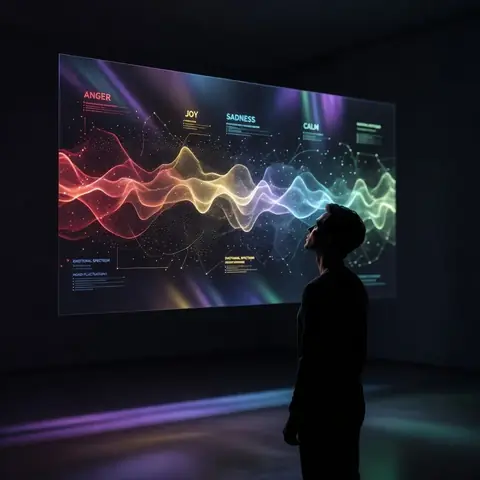
Researchers created AttuneBench to measure how well AI models understand and respond to human emotions in real conversations. This could help make AI assistants more empathetic and effective in daily interactions.
Researchers created a new test to see if AI can handle real-world drug design. This could change how we discover life-saving medications. The test, called SMDD-Bench, is the first to evaluate AI's ability to design drugs for real-world use. It focuses on small molecule drug design, a key area in medicine. The SMDD-Bench is a challenging, multi-turn, long-horizon agentic benchmark consisting of 502 tasks. It covers diverse chemistries and targets, making it a comprehensive test for AI's capabilities in drug design. This benchmark is designed to be more realistic than previous tests. It includes multi-turn interactions, which mimic the real-world process of drug design. This makes it a valuable tool for evaluating AI's potential in this field.

Researchers created a benchmark called MOOD to test AI models' ability to detect unexpected safety failures. This could help prevent AI from behaving dangerously in unusual situations.

A new report reveals that only a small fraction of AI computing power is used by labs working on the most advanced models. Most AI compute is still used for simpler, less innovative tasks. This highlights a significant gap in how AI resources are allocated.

Researchers introduced MindLoom, a framework that improves AI reasoning by breaking down complex problems into simpler thought modes. This could lead to more reliable and diverse problem-solving in AI systems.

Researchers have developed SOLAR, an AI agent that continuously learns and adapts to new information without forgetting old knowledge. This breakthrough could make AI systems more reliable in real-world, changing environments.