
New AI Benchmark Tests Scientific Reasoning in High-Stakes Fields
Researchers created a benchmark to test AI's ability to synthesize scientific conclusions. This could improve AI decision-making in critical areas like healthcare.
44 stories tagged Science · page 2 of 2
Researchers created a benchmark to test AI's ability to synthesize scientific conclusions. This could improve AI decision-making in critical areas like healthcare.

A new position paper argues that AI models should be studied as evolving processes, not just fixed products. The paper calls for a science of AI that focuses on training dynamics to better understand why model behaviors emerge, rather than relying on post-hoc fixes.

OpenAI's GPT-Rosalind now has enhanced biological reasoning, medicinal chemistry expertise, genomics analysis, and experimental workflow capabilities. This helps scientists analyze genomes and design experiments faster, accelerating drug discovery and genetic studies.

AI models can't reliably tell cause from effect, even with fine-tuning. Researchers prove this is a fundamental limitation and propose a new method to overcome it.
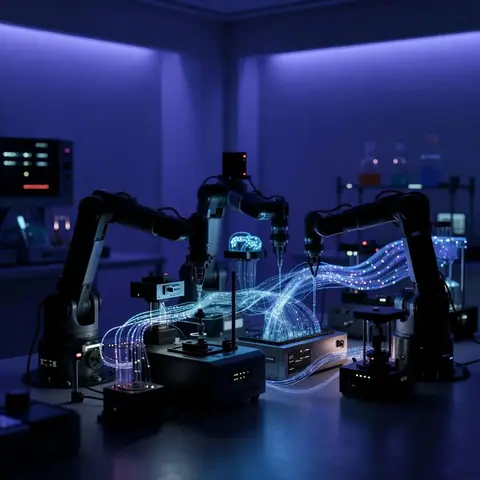
Researchers developed ScientistOne, an AI system that conducts research autonomously while ensuring claims are verifiable. This could make AI-generated research more reliable for scientists and professionals.

Harvard researchers have developed an AI system that can automate the coding process for scientific research. This could significantly speed up experiments and make advanced research more accessible to non-experts.

Researchers created an AI system that debates scientific ideas to generate new hypotheses. This could speed up discoveries in fields like battery research by combining fragmented knowledge.

Researchers created SciAtlas, a knowledge graph that organizes scientific research to help AI and humans find connections. It aims to solve the problem of too much fragmented academic information.
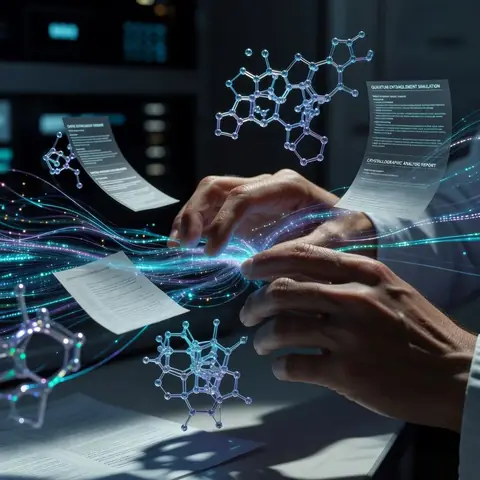
Researchers are developing AI systems that could automate entire scientific research processes, from literature review to final reports. This shift could make scientific discovery faster and more accessible, though challenges remain.
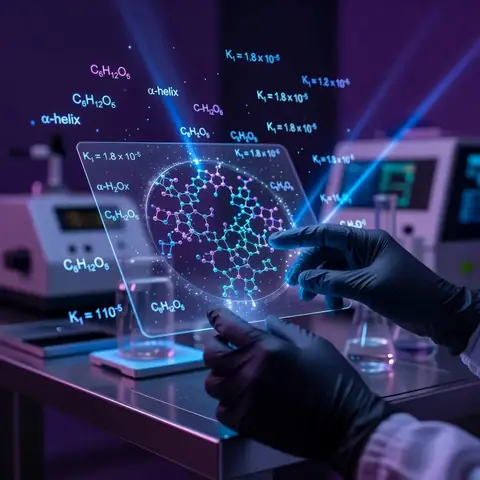
Researchers created a new test to see if AI can handle real-world drug design. This could change how we discover life-saving medications. The test, called SMDD-Bench, is the first to evaluate AI's ability to design drugs for real-world use. It focuses on small molecule drug design, a key area in medicine. The SMDD-Bench is a challenging, multi-turn, long-horizon agentic benchmark consisting of 502 tasks. It covers diverse chemistries and targets, making it a comprehensive test for AI's capabilities in drug design. This benchmark is designed to be more realistic than previous tests. It includes multi-turn interactions, which mimic the real-world process of drug design. This makes it a valuable tool for evaluating AI's potential in this field.

Researchers created AgentCo-op, a system that lets AI agents automatically build work teams for complex science problems. It could make scientific discovery faster and more accessible by automating team assembly.

Google DeepMind has launched Co-Scientist, an AI tool that acts like a team of research assistants. It helps scientists analyze data, write papers, and brainstorm ideas, potentially speeding up scientific discovery.

Researchers developed PROMETHEUS, an AI system that organizes causal claims from text into navigable maps. This could help scientists and policymakers make better decisions by understanding complex relationships in data.

Researchers found that AI systems often get stuck in repetitive thinking, limiting their ability to generate new scientific ideas. They discovered that teaching AI to use analogies from other fields can spark more diverse and creative solutions.

Researchers used AI to automate the design of complex scientific formulas, potentially speeding up material science breakthroughs. This could lead to better batteries, stronger metals, and more efficient solar panels in the future.
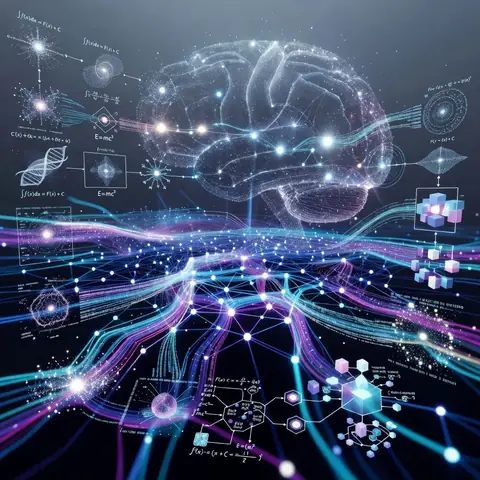
Researchers have developed an AI system that can automatically extract data from scientific literature, including text, tables, and figures. This could revolutionize materials science by making it easier to build comprehensive databases.

Researchers created a team of AI agents that collaborate to tackle complex scientific problems. This approach could make AI more reliable for tasks like weather prediction and climate modeling.

A new AI called Cajal can draft research papers and simulate peer review. This could speed up scientific discovery but raises questions about authenticity.
Researchers introduce FormalScience, an AI pipeline that helps domain experts formalize scientific reasoning into verifiable code. This addresses a key challenge in applying LLMs to scientific domains with complex notations.

Researchers have developed an AI model that simplifies complex particle physics equations by learning patterns similar to solving a Rubik's Cube. This approach could revolutionize scientific problem-solving and theoretical physics.