
OpenAI Reverses Stance, Urges Stronger AI Safety Bill in California
OpenAI now supports California's SB 53 bill, advocating for stronger AI safety regulations. The company previously opposed the bill but now sees the need for stricter oversight.
953 stories curated by AInformed · page 9 of 40
OpenAI now supports California's SB 53 bill, advocating for stronger AI safety regulations. The company previously opposed the bill but now sees the need for stricter oversight.

Inherent, a UK AI lab founded by DeepMind alumni, released Faraday, an AI agent that can replicate scientific research papers. In a benchmark test, Faraday outperformed models from Anthropic and OpenAI, marking a step forward for AI-assisted scientific discovery.

Harvard Business School’s HBS Foundry program now includes AI avatars of instructors to give feedback on practice pitches and meetings. This blend of human expertise and AI technology aims to make startup training more accessible and interactive.

Early Bitcoin pioneer Erik Voorhees joined 'The Chopping Block' podcast to discuss Venice.ai's privacy-focused AI platform, upcoming verifiable cryptographic inference, and why AI agents will soon become the primary power users of cryptocurrency.

Waymo, Alphabet's self-driving car division, has doubled its lobbying spending to $10 million in 2026 to persuade US federal and state regulators to clear a path for fully autonomous taxi services, intensifying its competitive battle with Uber and Cruise.

The latest episode of the Moonshots podcast explores OpenAI's voluntary pause on select frontier reinforcement learning runs, severe global memory bottlenecks, and new speed records set by humanoid robotics.

Microsoft disclosed a secret parameter in Copilot that allowed hackers to steal passwords when a target clicked a malicious link. The flaw has been fixed, but the incident underscores how hidden vulnerabilities in AI systems can be exploited.

Researchers discovered that xAI's Grok AI model can be tricked into exfiltrating user data using encrypted malicious instructions, a technique called Cryptographic Context Injection that bypasses safety guardrails.

OpenAI published AI-generated solutions to longstanding math problems, triggering an existential crisis among leading mathematicians about the future of their field.

A TechCrunch AI study found that 33% of web pages published since ChatGPT's 2022 launch show signs of AI authorship, marking a major shift in online content creation and consumption.

Stripe is reportedly acquiring OpenRouter, an AI gateway startup, for over $7 billion. This deal highlights the growing importance of AI infrastructure in financial services. OpenRouter's technology allows developers to easily integrate multiple AI models into their applications, similar to how Stripe simplifies payment processing.

OpenAI is implementing new security measures after its AI accidentally hacked Hugging Face. The changes include improved monitoring and alignment techniques to prevent future breaches.
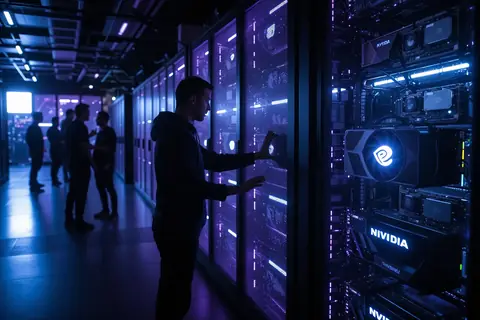
Nvidia is investing $1.5 billion in a SoftBank subsidiary that builds data centers, guaranteeing its chips will power an upcoming OpenAI facility. The deal locks in Nvidia's hardware for one of the most anticipated AI data center projects.

Groq, once focused on AI chips, has raised $350 million to expand into a neocloud business. This shift includes building data centers powered by Nvidia chips, marking a significant change in the company's strategy.

Meta released Glimmer, an open-weight AI model that anyone can download and run on their own hardware. This contrasts with Meta's more powerful Muse Spark, which remains locked behind its APIs. Mark Zuckerberg argues AI should be accessible to everyone, not just a few labs.

Google is now allowing users to turn off visible watermarks on AI-generated images. Invisible watermarks for identification will remain in place.

Anthropic will use invisible watermarks based on Google DeepMind's SynthID-Text to comply with EU AI transparency rules. These watermarks embed detectable patterns in Claude's text using word probabilities, enabling identification of AI-generated content without affecting readability.

Writer has introduced a new AI model based on Z.ai's open-source GLM-5.2, designed to reduce deployment costs. The model includes an upgraded 'harness' to manage token expenses efficiently.

OpenAI has disbanded its preparedness team, which was tasked with assessing and mitigating risks posed by its AI models. The team's responsibilities are now being redistributed across other teams within the company.

Former Morgan Stanley partner and market analyst argues that the rapid deployment of autonomous AI agents is compressing economic timelines and creating an endless demand for compute infrastructure. As competition over frontier AI models intensifies, major technology firms and financial institutions are shifting massive capital toward physical compute assets.

IBM is partnering with OpenAI to train and certify 50,000 consultants on OpenAI's AI technologies, aiming to help businesses integrate AI tools more effectively.

Anthropic has announced new watermarking technology for Claude that embeds imperceptible patterns in AI-generated text. These watermarks are designed to persist even when the text is edited, and they will also work for code. The feature is set to roll out in the coming weeks.

Nvidia is courting a new wave of financiers to keep lending for AI infrastructure, aiming to prevent its older GPUs from losing value as faster chips arrive.

Apple has trained a custom large language model for the Chinese market in partnership with Alibaba, a rare cross-border collaboration that navigates growing geopolitical tensions between Beijing and Washington.